

How to Spot a Hack Deck Builder Before You Sign
I'm Bill Holton, co-owner of Master Deck Builder Cleveland. I walk a lot of decks around Northeast Ohio, and I see a lot of work that was built wrong: frames that are already failing, posts heaving out of the ground, stairs that bounce. Most of those homeowners didn't do anything wrong. They just had no way to tell a good builder from a hack before they signed.
Here's what I'd look for if I were hiring someone to build my deck, including us.
By Bill Holton, co-owner, Master Deck Builder Cleveland
Red flags before you sign
The price is way below everyone else's
If three quotes are close and one is thousands lower, something is missing. It's almost never the boards, since everyone buys the same brands. It's usually the frame: shallower footings, smaller posts, wetter lumber, fewer details. The cheapest deck ends up costing the most.
The quote doesn't say how the frame is built
"Build 16x20 composite deck" isn't a quote. A real quote tells you footing depth, post size, framing lumber and how the deck attaches to your house. If it's not in writing, ask for it before you sign.
They push you to sign today
A deck is a big purchase. A builder who's confident in their price doesn't need a "today only" deal to close you.
No warranty in writing, or no one to call
The horror story I hear most: something went wrong, the homeowner called the builder, and nobody called back. Ask who you call in five years, and get the warranty in writing.
They can't show you their own work
Ask for photos of recent jobs, ideally including the framing stage, and reviews you can check yourself.
Already have a quote?
Send it to me before you sign. I'll go through it with you and point out what's there, what's missing, and what to ask the builder.
5 questions to ask any deck builder about the frame
A good builder answers each one with a number or a straight yes or no. Here are ours, so you have something to compare against.
| Ask this | What we do |
|---|---|
| How deep are your footings, and what shape? | Below the frost line, about 38" deep, belled from 12" at the top to 16–18" at the bottom, on a 12" concrete footer |
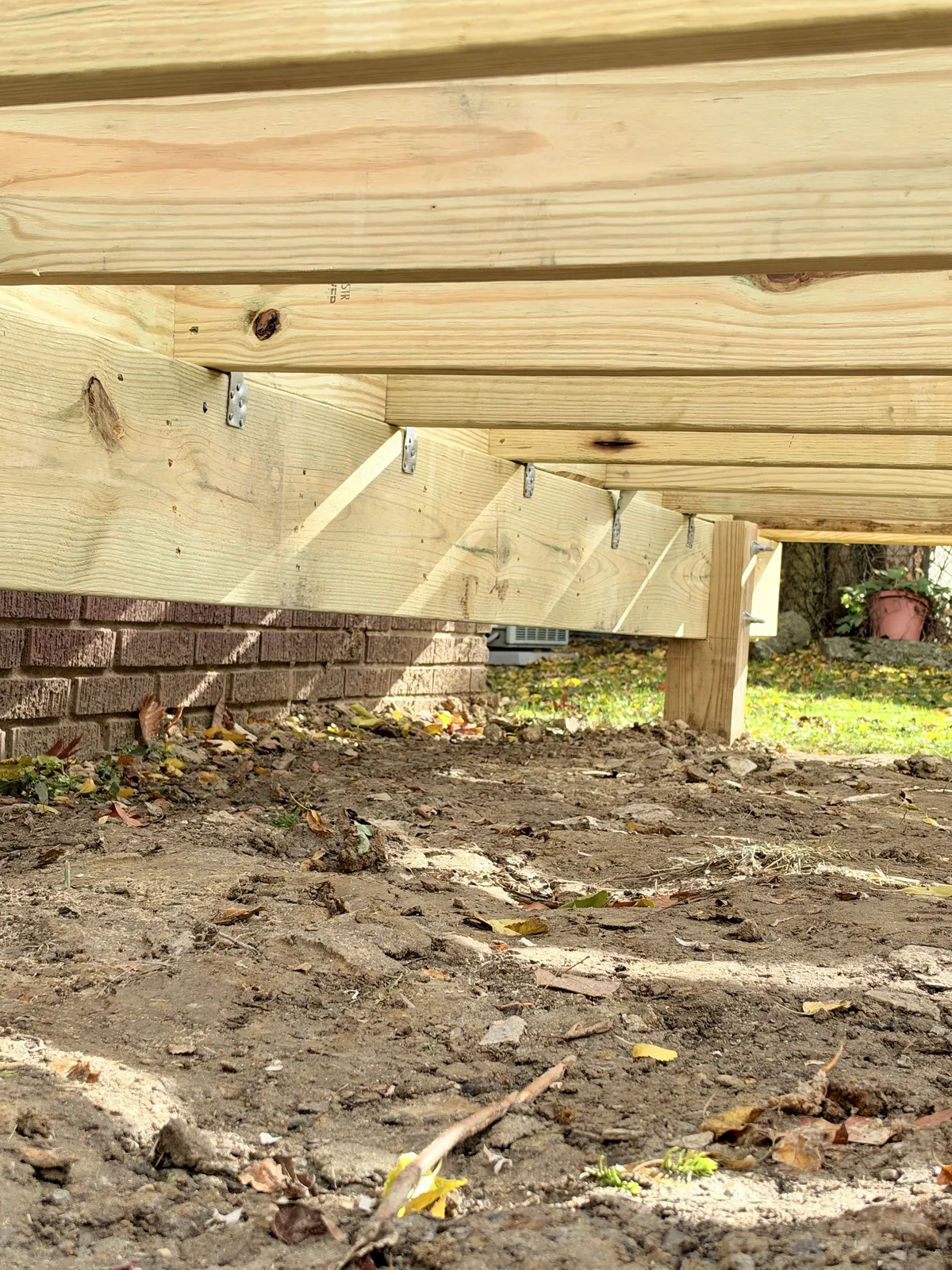
| What size posts, and how does the beam attach? | 4x6 posts, notched so the beam sits in the post, through-bolted |
| Kiln-dried lumber or wet pressure-treated? | KDAT, kiln-dried after treatment |
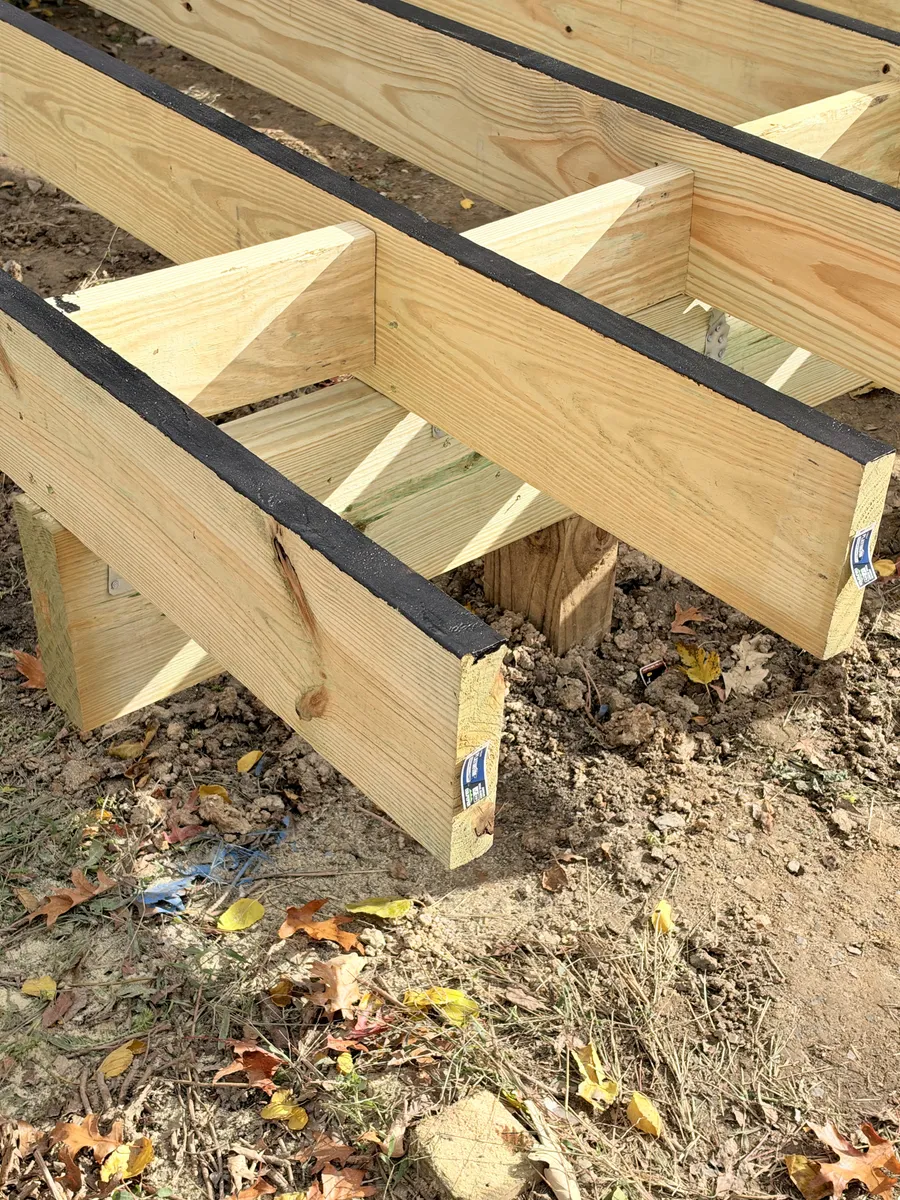
| Do the joists sit on the beam or hang off it? Are they protected? | On top of the beam, with joist tape on every joist |
| Freestanding or attached to my house? | Freestanding whenever possible. If a ledger is needed, we explain why |
Two more worth asking: "Do you cut your own stair stringers?" (we do) and "Will there be fascia covering the board ends?" (always).
How to spot a badly built deck in 30 seconds
Next time you're on a friend's deck, or looking at a builder's past work, check these:
- The stairs. Do they bounce or feel uneven? Look underneath. Pre-cut stringers from the home center are thin and notched deep. We cut solid stringers for every staircase.
- The edges. Can you see the cut ends of the deck boards around the outside? A finished deck has fascia all the way around, so no board ends show.
- The posts. Are they 4x4s with the beam bolted to the side? Are any posts leaning, or lifted out of the ground? That's frost heave from shallow footings.
- The surface. Wavy or cupped boards, or gaps that open and close, often mean wet framing lumber that kept shrinking after the deck was built.
- Where it meets the house. Rust stains, rot or gaps at the ledger board are bad signs.
- The bounce. Walk the middle of the deck. A springy feel can mean undersized or overspanned joists.
If you see two or three of these, the deck probably wasn't built to last, no matter what boards are on top.
How to compare deck quotes fairly
Make sure every quote you're comparing lists the same things: square footage, board brand and collection, footing depth, post size and beam connection, framing lumber, joist protection, freestanding or attached, railing type and length, tear-out, permits, and the workmanship warranty.
Then compare. If the cheap quote is missing half of that list, you're not comparing the same deck.
How we do business
- No pressure. I'll give you real information and a clear price, then it's your call.
- Published pricing. Most of our composite decks run $65 to $85 a square foot installed. We're not the cheapest and we're not the most expensive.
- Brian signs off on every deck. Brian has built decks for 35 years and trains every crew.
- We answer the phone. Every deck carries our Lifetime Workmanship Warranty for as long as you own your home.
— Bill Holton, co-owner
Choosing a deck builder: common questions
How do I know if a deck builder is any good?
Ask how they build the frame: footing depth, post size, framing lumber and how the deck attaches to your house. A good builder answers with specific numbers and puts them in writing. Then look at photos of their recent work and check their reviews.
Why is one deck quote so much cheaper than the others?
Usually because of the frame. Shallow footings, 4x4 posts, wet lumber and unprotected joists cost less up front and fail sooner. The boards on every quote are usually the same brands.
What should a deck quote include?
Size, board brand and collection, footing depth, post size, framing lumber, joist protection, freestanding or attached, railing, tear-out, permits and the workmanship warranty.
What are signs of a badly built deck?
Bouncy stairs on pre-cut stringers, exposed board ends with no fascia, leaning or heaved posts, wavy boards, rot or rust where the deck meets the house, and a springy feel when you walk across it.
Already have a quote? Get a second opinion.
Send it to us before you sign. We'll go through it with you and point out what's there, what's missing, and what to ask the builder. No pressure to choose us.
Copyrights 2026 Master Deck Builder Cleveland | Privacy Policy | Terms of Service | Warranty | Blog